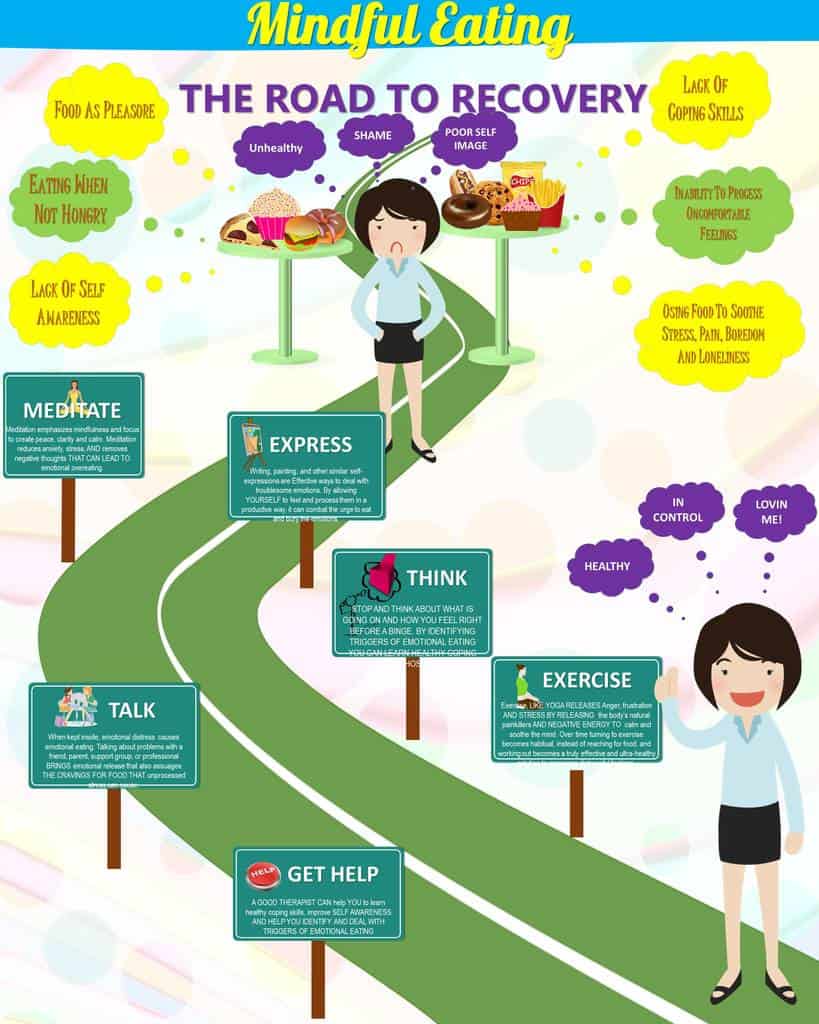
How Mindless Eating Can Destroy Your Health
 How We Eat Affects Our Weight And Health
Everyone knows that maintaining a healthy diet can have a very positive effect on your life, but most people still have no clue how far these benefits extend.
The majority of people around the world generally eat too many calories, and an excessive amount of sugar, salt, cholesterol, saturated fat, and alcohol. Even though they’re aware of their poor eating habits, it’s the taste of this unhealthy food that keeps them running back to it every day.
It can be difficult to stick to eating healthy for various reasons:
- Skipping meals (mostly due to lack of time) and overeating on snacks and fast food afterwards
- The incredibly easy access to snacks and fast foods
- People not knowing how to tell if a product they buy at the supermarket is healthy or not. Often, when you choose to buy a pack of low-fat cookies, they’ll contain other unhealthy ingredients to make up for the low fat content. In order to make them tastier, companies will put more sugar in the cookies, and they will end up having the same number of calories as the ones that contain fat
- One of the most common reasons why people fail in following a healthy diet is because they don’t understand what it means to eat healthy
Namely, just because you decide to eat healthy doesn’t mean that you should completely turn your back on comfort foods. In fact, a good diet is all about finding a great balance between eating healthy and unhealthy foods in order to keep both your body and mind satisfied.
This is why fad and commercial diets are useless, and you should instead focus on changing your lifestyle, and making profound dietary habit changes that will last a lifetime.
If you’re not following a healthy lifestyle, you should start immediately. There are numerous scientific studies that show that eating healthy can reduce the risk of serious conditions such as type 2 diabetes, heart disease, obesity, several types of cancer, stroke, hypertension, and osteoarthritis.
If you’ve set your mind to begin a healthier way of life and eat better for the first time in your life, stick with it and make gradual changes to your old unhealthy habits and never give up on your goals even if you fail the first few times.
Begin by identifying the root of your struggle with food. For example, are you having trouble with overeating, munching on snacks too much, consume too much sugar, or if you’re in the habit of mindless eating.
What Is Mindless Eating?
Did you ever eat a whole quart or more of ice cream while watching one of your favorite TV shows even though a small scoop would have been enough to satisfy your need for a delicious treat?
When you don’t pay attention to the food you’re eating and do not notice how much food you have consumed, then you have a habit of eating mindlessly
Mindless eaters don’t pay attention to food as much as they should, which is why it’s often typical for them to eat a piece of cake even when it’s stale and doesn’t really taste that good.
On the other hand, a mindful eater is aware of everything they eat and they use this awareness to maintain a healthy lifestyle.
Examples Of Mindless Eating
The best example of mindless eating would be popcorn at the movie theater.
Namely, the taste of the popcorn (according to an experiment that is mentioned in the book Mindless Eating: Why We Eat More Than We Think, written by food psychologist Brian Wansink) doesn’t even matter to people who are in the theater. Even if it’s stale, they will eat it because they aren’t paying attention to the food; they’re paying attention to the movie.
There is no attention paid to the portion being consumed or the fact that a half a cup of popcorn is all that is really needed for a snack, and the movie portion is more like 4 cups. As long as the movie projectors are still running, we will be munching on the snack.
Since all of your attention will be directed towards the movie, you will not notice how much of it or how fast you’re eating or even realize that you’ve been full for some time.
The aforementioned food psychologist, Brian Wansink, notes that there is a huge difference between eating until you’re full and eating until the plate is empty. The latter means that you’re probably eating mindlessly.
Another example is eating in front of the television where you hardly pay attention to the food, what you are eating, or how much of it you ate.
Eating while driving is likely to cause mindless eating, since you cannot really devote attention to the food because it’s devoted to the road.
Mindless eating is a habit that people develop early on in their lives. For example, many kids fall into the trap of eating this way due to the size of the bowl from which they eat their cereal. Namely, if you give a kid a 16-ounce cereal bowl, they will pour much more cereal in it than if you gave the same kid an 8-ounce bowl.
What Happens During Mindless Eating
Although people generally have no clue about a process known as the mindless margin, health experts are well aware of its occurrence. If you’ve ever noticed that you’ve been gaining weight despite not changing your exercise or eating patterns, then you’re probably experiencing the effects of the mindless margin.
So, what is the mindless margin exactly?
It’s a calorie range where we are totally unaware of the small changes we make to our eating habits. The mindless margin notes that a difference of up to 100 calories will go unnoticed, which would make you gain/lose weight gradually.
While eating mindlessly, it is impossible to realize when hunger has been satisfied. That’s because you shouldn’t really ask yourself whether you’re full or not; rather, you should determine whether you’re still hungry.
The next time you’re eating a meal make sure to pause for a few seconds after a few bites in order to determine whether you’re still hungry. If you aren’t hungry, then you should stop eating. Eating to satisfaction and not to feeling stuffed is a key habit change towards the healthy.
Our Super Sized World
People generally eat much more than they should, which is exactly why obesity rates in the United States are at epidemic levels, with 1/3 of adults being obese, and the picture is not much better in other parts of the world.
We are a “super size” world, with larger Fries, extra large tubs of sodas and restaurant portions that are large enough to make 4 or 5 sensible meals.
Overeating can lead to numerous health risks, so you need to pay attention to how you’re eating. In fact, studies mentioned in the book Mindless Eating: Why We Eat More Than We Think, concluded that people can eat 20% less than what they are used to without ever noticing any difference.
That 20% is the main difference between feeling like you’re not hungry anymore and feeling like you’re full.
When it comes to food perception, the portion size doesn’t matter as much as we think. In fact, an experiment published in a diet book called the Volumetrics Eating Plan, written by Dr. Barbara Rolls, found that people could eat as much as 50% less food than they initially set out to consume and still feel full. To prove this, Barbara decided to put a quarter-pound hamburger right next to a half-pound one in front of certain people.
So what happened?
After the people got instructions to eat only the quarter-pound one, they were still hungry after eating it, having already noticed how smaller it is than the half-pound hamburger. However, when she decided to add more onions, tomatoes, and lettuce, as well as not squish the quarter-pound burger down in order to make it look bigger, she was surprised to find out that people were not hungry after eating it.
This shocking discovery made her realize that our eyes and how we see the food we eat has a significant influence on our eating habits.
You have to become aware that neither your stomach nor memory will help you in determining just how much you actually eat.
When you’re going out to eat with a couple of friends and you order some French fries; there is no way too remember how many fries you ate after finishing the plate because you will be distracted by conversation.
This is why you need to plan ahead and understand how to become a mindful eater instead.
 The Consequences Of Mindless Eating
Mindless eating is a real problem as it poses various health risks, and you may not even know it’s happening. Since most of us develop this habit at a very young age, we have no clue about the toll it takes on our quality of life.
For example, we hardly ever get to enjoy the food we’re eating.
Instead, we are just enjoying the distraction (driving, watching TV, reading a magazine, book, or newspaper) that comes along with eating our food. Basically, many people are only eating to satisfy their hunger and not to really enjoy their meals.
Instead of food, most people have just about anything else on their minds while eating. Some choose to do computer work, homework, or other tasks while eating, while others enjoy a late night meal in the living room, watching their favorite TV show.
And it’s not necessarily a problem with not wanting to appreciate the food they’re eating, rather it’s people forgetting how they should separate other activities from eating.
Since mindless eaters don’t really pay attention to how much food they’re consuming, it leads them to overeat.
Overeating can lead to significant weight gain and obesity, which is associated with a wide array of health risks, including type 2 diabetes, heart disease, cancer, belly fat, and premature death.
To ensure you are leading a healthier lifestyle, you need to master the art of mindful eating.
Mindful Eating: A Much Better Option
Mindful eating is the exact opposite of mindless eating.
Instead of not paying attention to the food we consume, mindful eating makes us form a really strong connection with it.
Mindful eaters enjoy every bite, they pay attention to what they ate, and how much of it, which allows them to eat just the right amount of food at every meal and for every snack, ensuring they live a healthier life and weight.
This alone should be able to persuade you to become a mindful eater, but how does one do that?
The first thing that you should do is really acknowledge the food in front of you the next time you’re eating a meal. Turn off your TV, radio, smartphone and computer, and make sure to put away the newspaper and the book you’re currently reading. Make sure that you’re alone with the food and that you feel a true connection with it.
After taking a few conscious breaths, you can start taking the first bite. There’s no need to rush through eating. Engage all your senses and notice the textures, smells, and colors of the food instead of just focusing on the taste. Make sure you also pay attention to how your brain reacts to each food, so you know that you are truly enjoying your meals.
You may notice that by engaging all six senses, you’ll learn to appreciate even the healthy food you once perceived as ‘boring.’
Essentially, there are a few rules that you should follow if you’re trying to eat mindfully:
- You should eat with the intention of caring for your well-being
- You should always pay attention to the effects the food you’re consuming has on your body
- You should only choose to eat foods that you will truly enjoy
- You should be able to recognize your trigger foods (the foods that are most likely to make you overeat)
- You should always ask yourself if you’re still hungry before taking the next bite
- Pay attention to each bite, because a lack of attention results in your mind not registering how much food you ate, which can result in you thinking you need more food to feel satisfied
Be prepared to hit roadblocks while becoming a mindful eater, as there is an adjustment period whenever you are changing any eating habits, but you shouldn’t give up even if you fail several times.
KNOW THAT PERSISTENCE IS KEY IN LEADING A HEALTHIER LIFE
12 Ways To Mindful Eating
- Get rid of the distractions: Nowadays, most people search for a distraction when they’re eating. Some enjoy eating their meals in their cars while on their way to work, while other enjoy eating while watching a movie or a TV show or even reading a book. However, usually when you pair eating with any other activity, you will eat mindlessly. There is no way around it, other than to completely get rid of the distractions. It’s not that bad of an idea to actually sit down in silence and really taste and appreciate the food you’re eating. Use a fork and knife, take your time, and eat slowly to allow your body to register satiety and enjoy every bite. Devote all your attention to your meal from start to finish.
- Use all the senses: Use your sense of touch and smell to enjoy your meal. Pay attention to the aromas, the textures, and the taste of every single bite.
- Think before you eat: Identify any pitfalls that may lead you to wolf down food that you do not need. For example, if you have had a stressful day, identify this fact, and become aware of it so you can deliberately avoid stress related mindless over-eating.
- Make a list: Begin to think about what triggers you towards mindless eating. Is it the TV? The Super Bowl, movies? Perhaps, it is emotions or even going out with friends. Once you have your list you can make mindful choices in those situations to stay on top of your eating habits.
- Stop finishing your plate: Sure, we’re all used to finishing the entire plate and eating those last few bites even if we know that we’re full, but sometimes it’s better to just leave a piece of food there. In case you don’t want to throw away food, then you should make sure to put less food on your plate. Better yet, use smaller plates with strategic portions of each food group and then you don’t have to worry about portion control.
- Never eat from the bag or box: When you take a whole bag of chips to the couch, you will likely eat way more chips than you should, the same goes for ice cream, or even something healthy like nuts. Instead serve yourself a small portion in a bowl, 6 chips, a handful of nuts or a small portion of ice cream and then eat only what is there.
- Learn to identify real hunger: The next time you decide to grab a bag of chips, make sure you ask yourself if you’re in the mood for a fruit or a vegetable. If the answer is no, then you need to be aware that you weren’t really hungry in the first place, and maybe you are just bored and it’s maybe best that you put down that bag of chips.
- Eat more slowly: In case you were unaware, it actually takes up to 20 minutes for you to digest the food and realize its effects. That’s exactly why you need to make sure you eat more slowly. This may be difficult for a lot people, which is why you need to come up with a creative way to force yourself to eat slower. For example, try eating with your other hand or using chopsticks for every meal.
- Reduce portions even when you’re eating out: When you are ready to order, make sure you tell the waiter to pack up one half of your food to g and to only bring you the other half while you’re at the restaurant. Also, as soon as you sit down, make sure you say that you don’t want bread at your table. This way you won’t even have to look at it, which will surely make you avoid overeating.
- Just because you’ve started eating a few healthier meals every week doesn’t mean that you should also start eating more junk food: Some people often decide to more sweets and snacks as soon as they start eating a healthy meal per day, but this will only make you an even bigger mindless eater. People generally do this because they feel like they deserve it for managing to even start eating a little healthier. However, they ultimately end up overeating instead of maintaining a healthy balance.
- Try avoiding eating in groups: When you eat your meals with a group of people, you will surely eat much more.
- Finally, you shouldn’t skip meals: Skipping meals will make it much harder for you to become a mindful eater. When we skip meals, we let the hunger take over our brain and that leads us to whatever is closest to us, which is not a healthy decision in most cases. To make matter worse, it also makes you more likely to overeat when you finally get your hands on a plate of food because your blood sugars are low and you are famished, making it very difficult to make mindful decisions about food.
- Eat every 3 hours: Some people eat breakfast just because it’s 8 in the morning, and not because they’re hungry. Pay attention to the signals your body and mind is sending you instead of following your habits. Better yet, eat a small meal every three hours, which includes real whole food, a lean protein, vegetable and a small portion of healthy fat, like avocado or olive oil. This helps keep your blood sugars stable, and revs metabolism.
- Try taking the ‘eating pause’: Some find it to be a strange concept, but it actually works. The next time you’re eating a meal, try taking a break from eating for a few minutes during the meal. After 5 minutes have passed, look at your plate and try to determine if you’ve had enough to eat. Don’t ask yourself if you’re full! Instead, ask yourself if you’re still hungry. If you’re still experiencing hunger, then you should go ahead and eat; but if you aren’t hungry anymore, then it’s best to leave any leftover food alone.
- Don’t let the labels fool you: Then next time you’re in a supermarket, make sure you don’t let certain food labels fool you. In most cases, foods that are advertised as sugar free or low fat are incredibly unhealthy. The products may be sugar free, but they contain a huge amount of artificial sweeteners. Similarly, a product may be low in fat, but it probably contains a lot of sugar.
Final Thoughts
Many people fall victim to the mindless eating habit, which can potentially be harmful to your health. Mindless eating can lead to overeating, resulting in significant weight gain and obesity.
This habit often occurs because people don’t really pay attention to the food they’re consuming, as another activity is on their mind.
Because of this, most people just wolf down their meals, and they don’t even get a chance to notice if they’re full or not, they just eat until there is no more food left.
In order to stop eating mindlessly, one has to become a mindful eater. This means that you need to form a strong connection with the food you’re eating and acknowledge how your body reacts to it.
Mindful eating is one of the key elements in making profound dietary habit changes that will lead to permanent and sustained weight loss and weight management
GET A FREE INFO POSTER AND THE PDF OF THIS POST HERE